ShareThis

This website is an online environmental resource for kids to find ideas, information, and inspiration to go green.

Join My Mailing List!


Well said...

"If I had influence with the good fairy who is supposed to preside over the christening of all children, I should ask that her gift to each child in the world be a sense of wonder so indestructible that it would last throughout life." Rachel Carson


Visit My Shop

Redwoods by Jason Chin

“Stunning... inventive... eye-opening...”
-Kirkus Reviews

REDWOODS
by Jason Chin

RedwoodsBook.com

email me for advertising rates

Sunday, April 26, 2009

Meet Tim Magner, Part 2


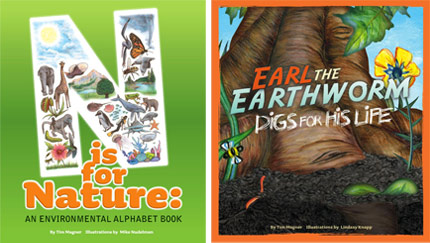
We are back with more questions for author Tim Magner, about two more of his books for young readers: N IS FOR NATURE: AN ENVIRONMENTAL ALPHABET BOOK and EARL THE EARTHWORM DIGS FOR HIS LIFE.

Both of these books aim to teach kids about many of the creatures we share our planet with, even the microscopic ones burrowing right under our feet! In your opinion, why is important that kids learn how other creatures live?

Since the beginning of human history, kids played outside. As part of every normal childhood, kids had plenty of time to wander, investigate and discover. Digging in the dirt and imitating animals gives them a chance to bond with the earth around us. Toddlers can identify with animals (especially young ones) and they grow into explorers who come to understand the connections and see us as a part of nature. Sometimes it's important to remember our roots.

EARL THE EARTHWORM DIGS FOR HIS LIFE teaches us about the amazing work of worms and how we can use them to create compost from our organic waste. Is this something that even city kids can do?

Our Earl story is entertaining in and of itself, but it's also about how, in nature, waste equals food. I love visiting schools and bringing some of my worms. Many of the city kids have never felt worms and can't believe I keep 1,000-plus of them in my kitchen. Vermi-composting is a way to explain nutrient flows and cycles. I'm a big proponent of the benefits of systems thinking over linear thinking and using nature as a model to help us move past the short-term thinking of the Industrial Revolution to a better future.

Your books really encourage kids to get outside and play. What was your favorite game to play outside when you were a kid?

We lived near a golf course and my brothers and I hunted for golf balls in the creeks and ponds. We came home well after sunset, covered in mud. Mom yelled at us. We also got to spend chunks of time in Wisconsin where we played with neighborhood kids, games like kick the can and flashlight tag. Good clean fun means getting dirty.


Tuesday, April 21, 2009

Happy Earth Day!


Join in on the fun and renew your commitment to help protect our planet at an Earth Day event in your community. Visit The Earth Day Network to search for events taking place in your area.

If you'd rather stay close to home, why not pick out a green activity or find a new way to get involved?  (And get your family and friends involved, too!)

Let us know what you are doing for Earth Day!

Sunday, April 19, 2009

Meet Tim Magner, Author of AN ENVIRONMENTAL GUIDE FROM A TO Z


Just in time for Earth Day, we have a special interview with Tim Magner, the author and publisher at Green Sugar Press, whose books encourage kids to explore, examine and investigate the natural world around them. His book AN ENVIRONMENTAL GUIDE FROM A TO Z, provides 26 opportunities for kids to learn about the Earth they live on. From the Amazing Amazon to the Zoo, every letter explores a topic, idea or solution to better help kids comprehend and care for for the environment. Let's ask him a few questions!

What inspired you to write AN ENVIRONMENTAL GUIDE FROM A TO Z?

Patrick, one of my seventeen nephews, and now in 3rd grade, kept telling me about what he was learning in school—from the destruction of the rainforest to the struggling polar bears. He was sad. I chose to write a book about the wonders of the natural world and to encourage kids to get out and learn more about it by enjoying it.

What is you favorite letter in the book and why?

Can I have two? "L is for Lugari" is fun because I spent a couple weeks in Colombia visiting with Paolo Lugari and Gaviotas. Seeing firsthand how Lugari turned a wasteland into a new forest was over-the-top cool. I also love the "C is for Cycle" page, probably because I like conversations about how nature has no garbage dumps. When I visit classrooms I usually bring my worms and explain how they eat my left-overs and turn it into a valuable fertilizer for my plants.

Your book explores many different regions and people in the world. Why should a kid living in a city care about Mt. Kilimanjaro or the Inuit Eskimos?

Funny you should ask. Actually, I believe it's far more important they first know their backyards or nearby park than Africa or the Arctic. Learning about nature starts with the nearby and expands, so we included ideas to get out and learn more about what's around them, i.e. "Have you considered keeping a journal of your local habitat—to write about what you see, smell and hear?" 


What is the single most important idea about the environment that you wish all kids knew?

Again, just one?
I want kids to know that exploring outside is loads of fun and, chances are their parents and grandparents got to have more fun than they did because they got to play outside often.
As John Burroughs said, "Knowledge without love will not stick, but begin with love and knowledge is sure to follow." So, once kids fall in love with the earth, they'll learn that we need nature for everything in life. Better yet, nature teaches us everything we need to know—from energy flows and nutrient cycles— to create a better future. 

This is the most exciting time in the history of the world to be alive. 

Monday, March 30, 2009

The Votes Are In!


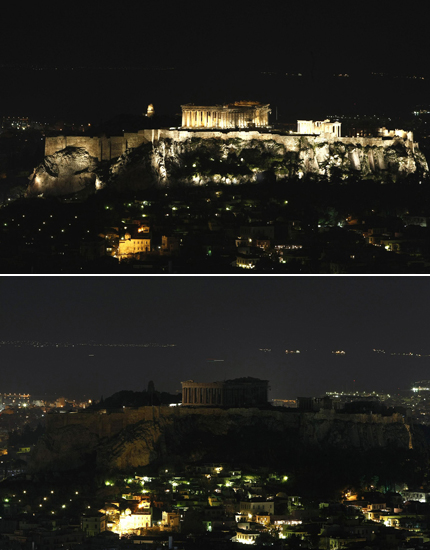
Earth Hour was a success! Lights went out in 4,085 cities in 88 countries in what is being described as the largest demonstration of public concern about climate change in history.

Take a look at these amazing before and after pictures of landmarks around the world plunging into darkness for one hour.

Tuesday, March 24, 2009

Too Young to Vote?


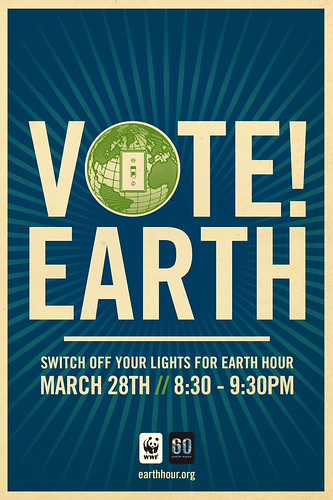
You might have been too young to vote in the recent presidential election, but don't let that stop you from voting with your light switch for Earth Hour 2009. On Saturday, March 28 at 8:30 PM, as many as 1 billion people around the world will turn off their lights in a universal vote to stop global warming. The World Wildlife Fund will present these votes at the Global Climate Change Conference in Copenhagen this year. At this important meeting, governments from all over the world will gather to decide how to fight global warming.

Earth Hour began in Sydney, Australia in 2007. 2.2 million home and businesses switched off their lights for one hour. The following year, Earth Hour went global, with 50 million people world wide sending a powerful message against global warming. Important landmarks such as the Golden Gate Bridge in San Francisco, the Sydney Opera House, Rome's Colosseum, and the Coca Cola billboard in Times Square all went black.

This year, you can VOTE EARTH just by switching off your lights. Visit Earthour.org to sign up so that they can count your vote.

Friday, March 20, 2009

Meet Jason Chin, REDWOODS author and illustrator, part 3


Green Guide for Kids: Why do Redwood trees grow only in the Northwest of the U.S.?

Jason Chin:
Redwoods can actually grow in many places, but the tallest and oldest trees grow in the northwest United States, because the climate there is best for them. To grow tall redwoods need a lot of water, and that area of the country gets a lot of rain--in fact the coast redwood forests are rain forests.

GGFK: Are the redwoods endangered?

JC: Redwood forests aren't on the US government's endangered species list, but there are far fewer redwoods in the United States than there were a century ago. The main threat is logging. There used to be about 2 million acres of coast redwood forest in the US, but 95% of that has been cut down. Today, less than 106,000 acres of the original forest remain. Some of that original forest has been replaced a second generation of trees. An important distinction must be made between old-growth and second generation forests. Old-growth forests are the ones that we normally think of when we think of redwoods -- they are home to the tallest, most impressive redwoods. It will take thousands of years before the second generation forests that began this century to reach their height.


GGFK: Are their any species that live only in the Redwood forests?

JC: There are a number of species that live only in old-growth forests. The spotted owl and marbled murrelet only nest in old-growth trees (both old-growth redwoods and douglas firs). These two species are endangered, since there are so few old-growth forests left and it take so long for new forests to grow back.


GGFK: What can we do to protect them and where can we learn more?

JC: There are many organizations dedicated to the preservations of old-growth redwood forests. One of the oldest and most respected is Save the Redwoods League, founded in 1918. Their website has a wealth of resources for kids and adults about redwoods including educational resources.

Tuesday, March 17, 2009

Meet Jason Chin, REDWOODS Author and Illustrator: Part 2


The Green Guide for Kids: Your book Redwoods comes out today, congratulations!

Jason Chin: Thank you very much, and thank you again for the interview.

GGFK: What are some interesting facts about redwoods that you think kids would be surprised to hear?

JC: Well, the obvious fact is that they are the tallest trees in the world and most people know this already. But with a little context this fact becomes much more interesting: They aren't just the tallest trees, they are the tallest living things on the planet! And the tallest of them all, the tallest living thing on earth, is named Hyperion at 379.1 feet tall. How tall is that? That's 74 feet taller than the Statue of Liberty!

GGFK: In your book, you talk a lot about the redwood canopy, something that not many people know about. Can you talk a little about the canopy here?

JC: Of course. In fact, this was my favorite part of the research. The redwood canopy is a remarkable place. Redwood crowns are very big and very dense, so much so, that from the middle of them you cannot see the sky or the ground. And inside them, researchers have found a wide variety of other plants growing hundreds of feet above the earth. These including ferns, bushes and even other trees. In one instance, researchers found a new redwood taking root on the top of a fully grown redwood!

GGFK: In the book you talk about how important redwoods are to their ecosystem. Can you talk about some other species that depend on redwoods?

JC: A very good example of their connection to other species is the fact that they make their own rain. The summers on the northern California coast have very little rain, but a lot of fog. The fog condenses on the redwoods' needles and then drips to the ground. In this way it waters itself and all of the plants around it! Many of the plants on the forest floor depend on this artificial rainfall for their survival.